HZh=
HZ– 6mm.24 in. (6/12)
– 9mm.35 in. (9/18)
– 27mm 1.07 in. (12/24)
In the cases where electrical connections cannot be done above the roof, bent elements are used. Sometimes the furnace is too high to allow installation of elements suspended from the roof, this is due to the limitation regarding the maximum permitted heating zone length. So, in such scenarios, it is necessary to install elements with bent terminals or heating zones. Most elements are bent in the cold end, but they can also be bent in the hot section. The hot zone of the MOSI2 heating elements can be bent at 90˚. This allows the installation of several rows of such heating elements on a wall of the furnace and it is also possible to control the power at different levels inside the furnace.
To support the terminals, bricks or fiber are used, which restricts the maximum furnace temperature to 1600°C.

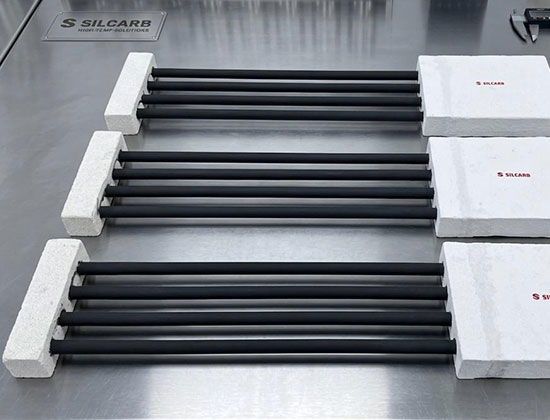
MoSi₂ Hot Bent Heating Elements are designed for furnaces where both vertical space constraints and high power density requirements demand flexible element geometry. By bending the heating zone itself—typically at a 90° angle—these elements enable side-wall installation while maintaining an effective heating length inside the furnace chamber.
Hot bending allows optimized placement of the heating zone closer to the process area, enabling multi-level heating arrangements and improved temperature profiling. This configuration is particularly useful in tall furnaces or furnaces requiring staged or zonal temperature control across different heights.
MoSi₂ Hot Bent Heating Elements are used in furnaces where standard straight or cold-bent elements cannot provide adequate heating coverage due to furnace height or installation constraints. The ability to bend the hot zone enables wall-mounted installation of multiple heating rows, allowing precise control of temperature gradients at different furnace levels.
These elements are well-suited for applications such as ceramic sintering, electronic ceramics, specialty glass processing, advanced metallurgy, and other high-temperature thermal processes where controlled, multi-zone heating is critical. The use of brick or fiber terminal supports ensures mechanical stability while defining the maximum operating temperature of the furnace system.